← Back to Portfolio

CASE STUDY

Media Ecosystem Architecture

Richard Hall (Moby)

Media Ecosystem Architect

Designing and implementing a scalable digital media ecosystem that centralized decades of music, video, photography, artwork, documents, and production assets into a searchable, preservation-focused platform supporting ongoing creative production and long-term archival management.

Replace with application screenshot or video

Executive Summary

Richard Hall's creative archive spans more than three decades of music production, film, photography, artwork, business records, and digital media. Hundreds of thousands of assets existed across aging hard drives, obsolete storage formats, inconsistent folder structures, and independently managed collections accumulated over decades of production.

Rather than simply reorganizing files, I designed a complete media ecosystem capable of preserving, organizing, searching, reporting, and managing creative assets throughout their lifecycle while supporting both historical archives and ongoing daily production.

The Challenge

My Role

Media Ecosystem Architect

As Media Ecosystem Architect, I designed and implemented the overall architecture supporting the preservation, organization, discovery, and operational management of Richard Hall's digital media archive. Responsibilities included information architecture, digital preservation strategy, metadata schema development, Python automation, cloud infrastructure, database design, custom software development, workflow engineering, reporting systems, and long-term archive planning.

Solution

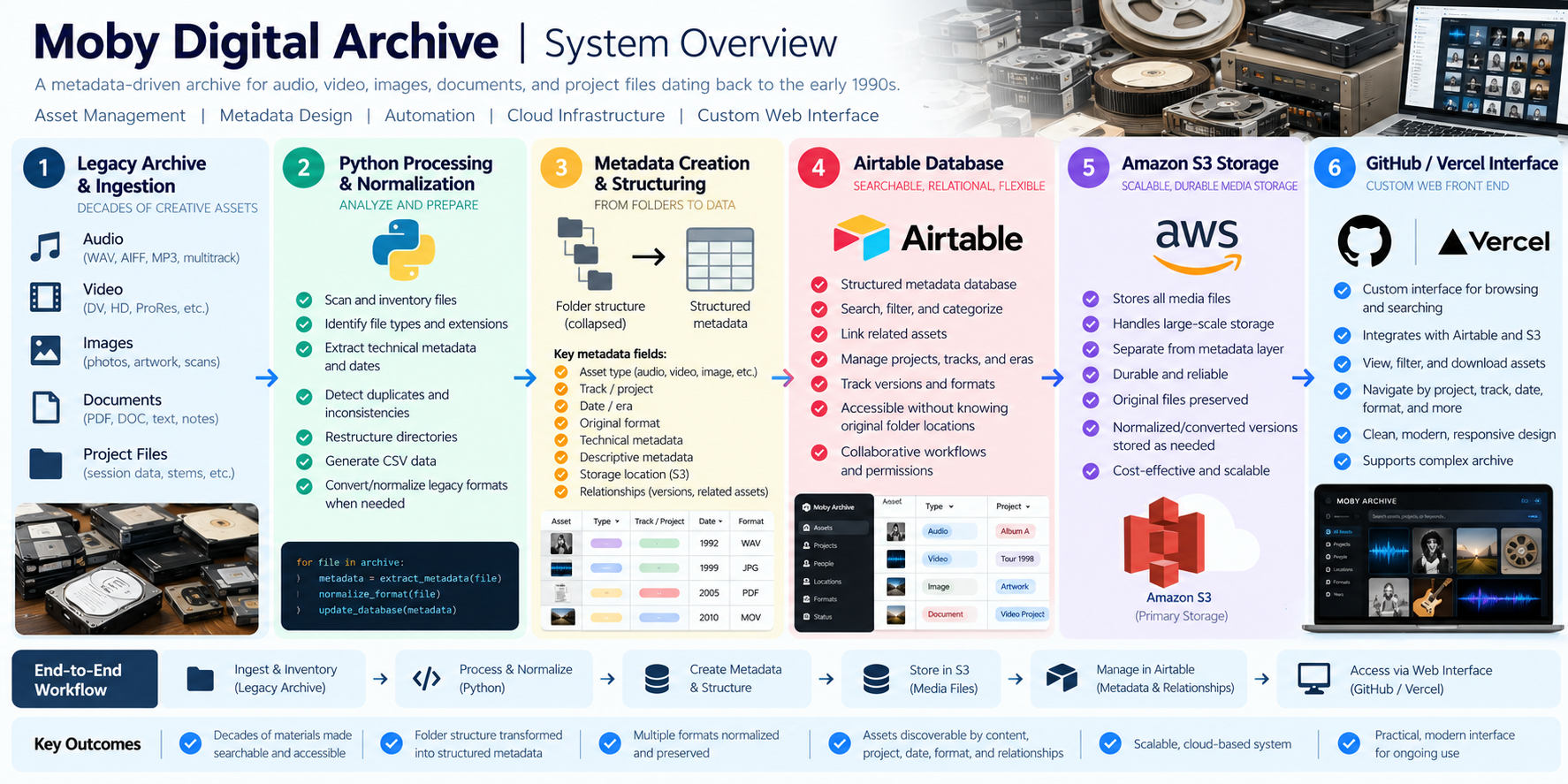
The archive was redesigned as a searchable information system rather than a collection of folders. Python automation processed hundreds of thousands of files by collapsing inconsistent directory structures, normalizing filenames, extracting metadata, generating checksums, identifying duplicate assets, and producing structured indexes suitable for database ingestion.

Amazon S3 became the centralized preservation repository. Airtable served as the metadata database supporting rapid searching, filtering, reporting, and relationship management. Custom React applications deployed through Vercel provided intuitive interfaces for browsing, searching, and managing assets across the archive.

Production Workflow

The ecosystem supported both historical preservation and active production. New music, video, photography, artwork, and promotional media entered standardized workflows before becoming part of the permanent archive.

Results

Reflection

This project demonstrates systems thinking across digital preservation, information architecture, workflow engineering, cloud infrastructure, software development, and media asset management. The objective was not simply to organize files, but to transform decades of creative work into a centralized, discoverable, reportable, and sustainable media ecosystem capable of supporting both present-day production and long-term archival preservation.